Margot Hitchcock - Blackwood and the Central Goldfields: A Genealogical Perspective
Apr 30, 2026
A talk by Margot Hitchcock, historian of the Blackwood District Historical Society, presented to a genealogical society. Dressed in 1860s period costume, Hitchcock shares background material from her book 'Aspects of Early Blackwood' (co-authored with Alan Buckingham) and discusses resources available to family historians researching goldfields ancestors. She covers the discovery of gold at Blackwood in 1855 and its population boom to 13,000, the challenges of tracing ancestors who moved frequently between diggings, and the broader Victorian gold rush across Bendigo, Ballarat, Castlemaine, and surrounding fields. The talk includes vivid descriptions of the journey to the goldfields, living conditions on the diggings, the role of Chinese miners, notable nugget discoveries, and the hardships faced by women and children. Hitchcock also describes her work with the Blackwood Historical Society's reenactment team and her research using school records, electoral rolls, mining registers, and church records.
Transcript
The reason I came dressed up tonight was to show you what the pioneers wore in about the 1860s. Um, I belong to the Blackwood District Historical Society. I'm the historian, and part of our society dressed up and we are the reenactment team. Um, we do reenactments around Blackwood and around different areas, the Bland Arcadians Arts Festival. Uh, part of our group.
As policemen, part as bushrangers and part as miners, and we have a few ladies in our group who dress up like I do. Um, the dress. Was pointed, low-waisted in the front, um, the big sleeve and the hoop petticoat, uh, very hard to sit down on. Um, very awkward to go to the toilet. I don't know how they managed.
And, um, the hoop I've got to. Um, actually, they're cupboard runners. Um, they used to have steel or, um, band or wire or something. And I also had my pants on. Uh, and my little dilly bag used to carry the money and what have you in.
The purpose for my talk tonight is to give you some background material which I use for my book on the Blackwood Goldfields, and the book is Aspects of Early Blackwood. Uh, it deals with the goldfields, the landmarks, and the pioneers. Uh, I also want to give you some information on the surrounding gold mining towns of the central Goldfields. Most of you here are interested. Perhaps in researching your families of that area.
And a lot of you no doubt have some ancestors who spent some time on these gold fields. I shall present this talk with a view to give you some background material and the history on the places where your ancestors possibly could have settled, and in particular the original names of the gold towns. As in the case of Bendigo, which was originally called Sandhurst, uh, if you have a certificate, birth, death, or marriage certificate that states Sandhurst on it, and you're wondering where this is, this would be Bendigo. I shall also try to give you some idea of how they lived and the hardships these early pioneers had to put up with in their efforts to come out to this country and settle in the gold rush days. I shall begin my talk with a brief account of the background history of Blackwood, from a genealogical point of view, realising that this town has a limited interest to some of you, but I will, Then go on to the surrounding towns where I hope to be able to give you some detail of such towns as our ancestors might have lived in.
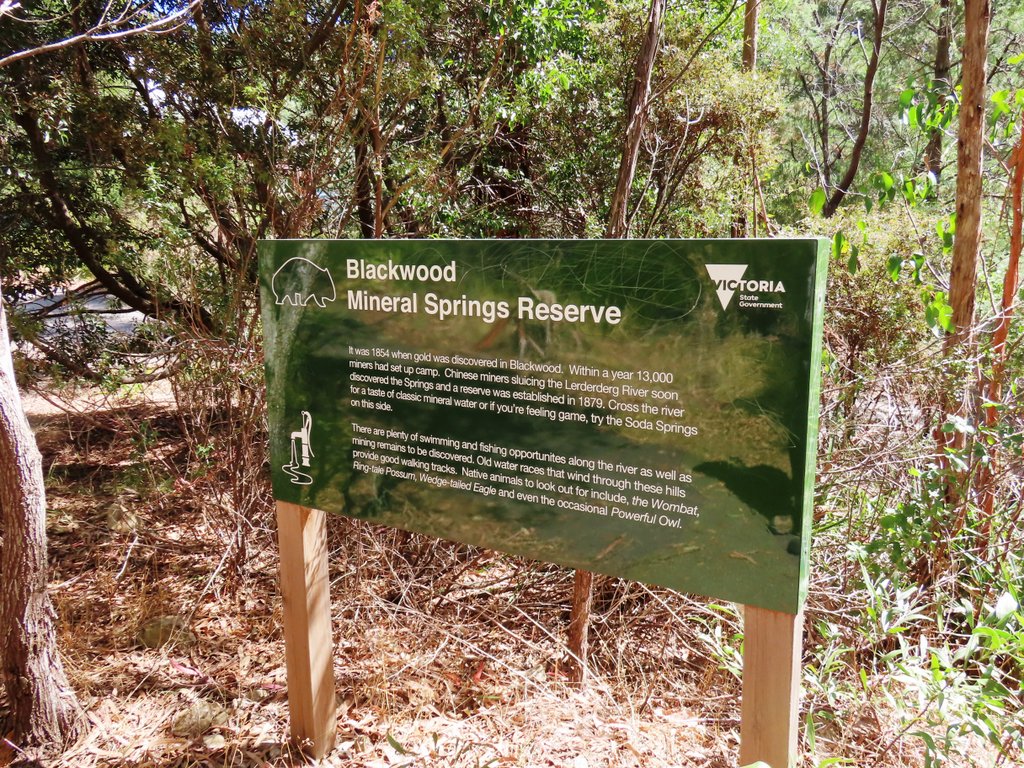
Um, I have a map here on the back wall. Some of you don't know where Blackwood is, you might have a look afterwards. It's a small town about an hour and a half drive from Melbourne. Uh, it's situated off the Ballarat Highway between Bacchus Marsh and Daylesford. The Lourdi Derg River runs through the Loodi D Gorge from Bacchus Marsh to Blackwood.
Uh, it's a delightful little town. There's only a pub and a general store, and there is a uh mineral springs have delightful mineral water, which, uh, I think it's better than Dale said, but I'm prejudiced, and, uh, it's situated in the. great dividing range and it's a delightful place to get away from Melbourne. I think there's not many places like it as close to Melbourne where you can get away. My grandfather built a holiday house there in the 1930s.
He bought a school that had been closed down that had been built for the miners. And out of that timber he built a holiday house and another house which he sold, but he kept our house for the family, it's been passed down. From my mother and now to my sister and myself. Uh, not many people have heard of Blackwood, uh, surprisingly enough, even though it's so close to Melbourne, but in its heyday, it was the biggest gold town closest to Melbourne. In 1855, when gold was first found there, the population reached an estimated 13,000 people.
Can you all hear me up the back? Bit louder, right? I'll try. I got over my nerves. But as with all gold mining towns, the population rose and fell, and as soon as the gold was extracted and they exhausted the field, they moved on to different areas.
There this is one reason why it is so hard to trace your ancestors on the gold fields as they never stayed very long in one place, enough, long enough to register any information on their families. My job as historian for the Blackwood Historical Society brings me letters from genealogists who, when they find a birth, death, or marriage certificate with Blackwood on, they write and asking for more information. Probably some of you have done this to other historical societies. I've got a whole file for. Um, to help me with this, I have got a lot of records of the schools and pupils who lived in the area, which I got from the history section of the education department.
They've been very helpful. I have compiled histories of all the schools in the areas around Blackwood for me free of charge, which is really great, typed it all up. And I've also included photostat copies of lists of pupils that were at the school. Um, you don't get a full list of the pupils only if, um, there's been petitions that have gone backwards and forwards. They wanting the school made bigger and they tell you how many children there are.
Uh, and these are held now out at the Public Records Office at Laverton, but they will bring them up into the city office for you. I also have copied out items of interest as they appeared in the local papers around Blackwood, mainly, mainly the Bacchus Marsh Express paper. Uh, and I've put some of these on tape, uh, I have copies of some of these papers in at the Public Records Office. I've also collected early electoral rolls and post office directories of the area as well as, uh, cemetery index, which the Genealogical Society did here. And the archivist of our society.
Has copied off the birth, deaths and marriages of the Church of England register, and we both have started indexing early mining registers of the area. I don't want to get inundated with more requests, but if I can help you, I will. Over 8 years of recording and compiling information, I now have enough records to fill 4 big filing drawers, 2 cupboards under a bench with a desk open that my husband had to make because he got sick of seeing any boxes all around the place. But I still have a lot of history of the area to collect. My idea is to in future, uh, write another book, um.
Dealing more with the pioneers and photographs of the area, photographs of the mines as they were and as they are now. Um, the idea for this book that I did write in conjunction with another member of our society came after he had written to me and asked me would I help him. He had, um, written a book, uh, it was on accountancy. He was a teacher down at Bairnsdale, and because it was successful, he thought he might try and get his thesis published that he did for the Melbourne University when he was there in 1970. He wrote the thesis on the mining in Blackwood.
And he was told that he didn't have enough material. He needed some more, and so this is where I came in and I was able to Give him a lot of information. I said to him, Well, what's in it for me? And he said, Well, what do you think? And I said, can I be co-author?
So he said, All right, as long as my name comes first. And, uh, his name is Buckingham, so it starts with a B and it comes before H. So, And I did the photographs in the book. I bought a secondhand lens reflex camera and uh I copied off old photos and it's quite simple really. I just bought some extension tubes and uh just put them on your camera and with a bit of experimenting I found that they'd come up quite well.
I just sent them off to Pacific. They do nice black and white photos, glossy ones. And uh so I was able to have them in the book. I did the information on the pioneers and the landmarks and we did about half each, which worked out quite well. Luckily I had collected a lot of information on the history of the area, and it was just a matter of typing it up and putting it together.
Um, we had this book launched in the Blackwood Hotel, and, uh, I asked the executive director of the Central Highlands Regional Tourist Bureau, would he come down to Ballarat and launch it for me, and he said yes, he'd be quite willing to, and, uh, member of our society offered a dozen bottles of champagne, which I didn't knock back. And, uh, the hotel put on biscuits and cheese and uh. I did a bit of publicity around the local papers and we had a crowd in the pub and it was a great night, and the highlights of my life, it was really good. And uh I've had a lot of correspondence from the book and uh a lot of enquiries, a lot of old people have sent me photos and it's been a worthwhile experience. The first time a book has been written on the area.
And I am happy that I have had something to do with it, and I feel that it's preserved for future generations to be able to. See what that was like. Now I should go on to the rest of my talk about the central Goldfields area. The region of Victoria is located about the cities of Bendigo, Castlemaine, and Ballarat. I'm sure you've all heard of these towns.
Uh, contained in this area at one time, the majority of was the majority of the population of Victoria. Officials estimated that 30,000 adult men were on the goldfields in June in 1852 and 100,000 in 1855. It is in these areas that most of our ancestors came to in search of gold or to set up stores or other services and requirements for the diggers in the way of buildings, houses, schools, supplying machinery, tools, setting up hotels or sly grog shops. For those that found the gold, there are always those who would trade it for goods. Or even entertainment or pleasure, as one digger described it, gay women deluded, inebriated diggers into disreputable amusements.
Quite often the traders did better business than the gold miners. Most of the history of the central goldfields sprang from the search for the alluvial and deep shaft gold. After the city of Melbourne was almost brought to a standstill with a hurrying off to Bathurst in New South Wales, the mayor of Melbourne offered him a reward of 200 pounds in May 1851. For anybody who could find gold within a radius of 161 kilometres from Melbourne. Officially, the first gold found in Victoria was announced in the Geelong Advertiser on the 7th of July 1851 by James Esmond, who found gold at Clunes.
Some 2 weeks later, Michelle and Party made a discovery at Anderson's Creek near Warrandyte. This field proved to be so poor that it never attracted more than a few 100 people. The great bulk of Victoria's gold was to be found in the wild wide arc to the north and west between 50 and 150 miles from Melbourne. The next discovery was made by Charles Peters in late July 1851 near Mount Alexander, which is now called Castlemaine. Early in September they made their discovery public, and it is said That they gathered 50 pounds of gold in weight.
Soon the surrounding places of Forest Creek and Friars Creek were opened up. And one startling success. The next discovery was early in August 1851 at Bunningyong by Thomas Hiscock. I had hoped that he'd be related to me, but he spelt his name wrong. Later in August, uh, 10 miles away, the great riches of Ballarat was discovered.
By mid-October 1851, Ballarat was to reach its peak, a population of between 6 and 10,000. At the end of October, a rush to Castlemaine began bigger than Ballarat two months earlier, and by this time, thousands from South Australia and Van Diemen's land were beginning to arrive. By mid December, some 20,000 were in the area. Then gold was discovered in Bendigo and a new alluvial gold field was announced in the Argus on the 13th of December 1851. Esmond of Clunes, Michelle of Anderson's Creek, and Hiscock of Bunningyong each received 1000 pounds from the Victorian government for discovering gold near Melbourne.
Early in 1852, the whole of Europe was informed of the riches of Ballarat and Bendigo, and migrants boarded ships in thousands, prepared to endure 3 to 5 months at sea for a chance of independence. Mostly they were young men who never again saw their homelands. Hundreds never even reached the gold fields. They died and were buried at sea. Nearly half a million sailed from the British Isles to Australia in the in the 10 years following 1851.
In Melbourne there were so many new arrivals that it was impossible to find a room or a bed or even a bath at any price. Often travellers who had spent months in sailing ships from Europe arrived only to find that they had to sleep on the wharf. Later, the accommodation problem was solved partially by the government's building of two immigrants' homes. And this was followed by a larger building at South Yarra to hold 750 people. 1/3 of Being raised by public subscription, government, government also aided construction of a Wesleyan shelter and the Chisholm's reception centre.
The following year, more than 10,000 migrants sheltered in these five institutions, but all this was still inadequate. So government La Trobe set up Canvas Town on the west side of Saint Kilda Road, which could hold 7000 people. Most of the residents were the poverty-stricken families left behind by the diggers who had left them there while they. Tried their luck on the gold fields. Many a miner lost his wife or children here and never saw them again, owing to the fever and the poor conditions.
By winter, many thousands. Had moved across to the new houses built in Emerald Hill, South Melbourne, late in 1853, the canvas town was closed down. Most delayed as briefly as possible in Melbourne before taking off for the diggings, generally to Castlemaine or Bendigo. Old friends and shipboard acquaintances clubbed together and brought the necessary tools and supplies such as picks, shovels, axes, tin dishes, tents, clothing, blankets, firearms, lamps, pots and pans, and food supplies. There was a great rush from Melbourne and Geelong as people poured off ships and sent off, set off on the roads, closely followed by the ship's crews, leaving the ships in the bays almost deserted.
The ones who could afford it went by coach. Bulli drive or horseback. Many of the migrants spent their small capital within a few days on transport for themselves and their luggage and arrived on the goldfields penniless. Prevailing prices were bad enough, but few of the early migrants knew that Bank of England notes were not legal tender. In the colony and could be.
Cashed only at 15% discount. Many paid exorbitant sums for the landing of all their household chattels off the ships, and storage space was so limited and expensive. Some began to sell what they could by sitting near the wharf pathetically offering watches, clothes. Guns, books, furniture, etc. This gathering in front of the Customs house became, became known as Rag Fair and developed into a popular market as regular traders moved in.
Every kind of vehicle was in demand from horse and cart to the humble wheelbarrow. Long lines of men, bullock drays, and every other conveyance took to the rough roads out of Melbourne west to the distant ranges. Those who walked either pushed a wheelbarrow with their belongings in or carried packs on their backs like snails. It was a continuous procession over the bleak keel plains leaving Melbourne. The road no more than a track or a series of tracks.
Hundreds of yards wide had been churned up into liquid mud in winter. Which was knee-deep, those on foot crawled like flies across a plate of treacle, while those with bullock rays, it was a misery. It was, if it was not boggy and muddy in winter, it was foot deep in mud dust and pitted with deep ruts and holes in summer, making the journey almost intolerable. My own great great grandparents arrived in Melbourne from England in 1855 and went by bullock train to Bendigo. The only record of their trip is that my great grandmother, who was a small child at the time, had a bag of prunes for a pillow.
When she arrived there, they found she'd eaten the whole lot. Mrs. Charles Clay Clacy gives a vivid account of the journey from England to Bendigo in her book A Lady's Visit to the Gold diggings of Australia in 1852 to 19953. On arrival at the diggings, tents were set up everywhere with some means of identification. Scarves, anything out of the ordinary so they could find their own tent.
Stumps and packing cases were used as furniture, and a flower bag was prized as the basis of a rough rough stretcher. Most slept on the ground, sometimes on straw mattresses or leaves or bracken. And they even wore their clothes, all their clothes that they possessed. Thousands of people Digging, wheeling, carrying, and washing for gold with a constant sound of shouting, swearing, thudding of axes. Trees in summer water is scarce.
The heat was awful, and the dust from all the dugout holes choked the air. At night, men clustered around campfires or sly grog shops, talking, singing, drinking and fighting. Men often had to cart their earth 5 or 7 miles to wash for gold, owing to the lack of water in some places in summer. What water they had had become polluted, and bilious diarrhoea, generally known as dysentery, was common. Children were prone to this, and many a cemetery, as some of us will know.
Has filled with graves of these young children. By 1852, most husbands now sent for their families to join them. There were some 5000 women and children on the fields in January and by June about 10,000 were housed in primitive slab or stone huts as well as in tents. The official number of people rose from 19,000 in January to 3,030,000 in June. Nearly all new arrivals came from neighbouring colonies, some 30,000 by sea alone between July 1851 and April.
1852. Early in 1852, half of the new arrivals were from South Australia. They had left or were leaving for Victoria. Over 15,000 of these a year. Uh, had come by sea from South Australia carrying their swags, or they walked for 2 to 3 weeks.
The South Australian government fixed their price of gold some 10 shillings above the Melbourne price of gold to make sure that the gold came back into their territory. This proved successful, for over 1/5 of the first year's earnings at the Victorian mines were sent to Adelaide. Many South Australian diggers invested in land in their, in South Australia. A book I have brought with here to me tonight, uh, called Gold Escorts by Les Blake, gives a remarkable account of the Gold escort route from Mount Alexander, which is Castlemaine, to South Australia during the years 1852 to 1953. Miners on the field came from England, Scotland, Ireland, European countries, whites and negroes from America, Chinese from Canton.
The hardworking Cornishmen from Cornwall and tin, a tin mining country at the south end of England added their knowledge to the field, as did the Californian miners from America. We can see the remains, remainders of these pioneers with such names of places as German Gully, California Flat, Yankee Gully, and Welshman's Reef, etc. To a remarkable extent, the diggers lived and worked together in national groups. Often whole gullies were occupied by Irish Scots, American, German, Cornish men, or Chinese. Large groups were often together from the same towns such as Liverpool, Bristol, Paisley, or Cork.
Many dispute about claims developed into national. Oh. Gradually the town grew and government headquarters at the major diggings were quickly made into solidly constructed camps. Wooden barracks from the military and police for the military and police, courthouses, storehouses, and a big jail with the Union Jack flying predominantly above. Government and private escorts would take deposits of gold to Melbourne and could be claimed on production of of.
If you produce the receipt. Uh, let's see if you didn't lose it. Then Nearly, sorry, nearby was a main street or commercial centre with dozens of stores and eating houses, doctors, barbers, blacksmiths, etc. Each had their own place of business distinguished by their own flag. The stores carried a vast range of goods whose prices varied according to the season and the cost of cartage.
Trees left standing near the central parts of the diggings were covered with notices such as, My wife Elizabeth Blinkinson, having gone away with Jim the Sawyer, I will not be responsible for your debts and have nothing more to say to you. The newspaper had long missing friends columns by means of which families and friends tried to reunite. Copies of these papers may be held at the La Trobe Library or in microfiche for the public to view. Seasonal factors also increased the digger's mobility. For example, Bendigo, a dry digging, was popular in winter, and Castlemaine in summer.
The great rushes of the early years involved up to 30,000 men and more to Mount Alexander, or Castlemaine it was known, and the end of 1851, Bendigo, about 18 May 1852 MacIvor, which is now called Heathcote. In the mid 1853s back to Ballarat and Tarragara, or as it's now known, Malden. At the start of 1854 to have opened Maryborough and later in 1854, Maliel and Inkerman and Fiery Creek, which is now known as Beaufort in 1855. Some of the more important minor rushes involving several 1000 men were at Mount Curong, now called Wedderburn. About September 1852, the ovens, which is now called Beechworth, at the close of 1852, several in 1853 at the Dunalley region of Tarangalla, King Gower, Sandy Creek, and Malligal.
And in 1953 again to Waranga, which is Beechworth and Ru area. To Ararat in 1954 and early 1955 to New Bendigo, it's now called Saint Arnold, and of course Blackwood. From 1851 through to 1856, the Castlemaine area remained constantly attractive. Bendigo held up well until late 1855, and Ballarat again became popular late in 1952, gradually built up to become the most important field of the mid-1950s. Then the rushes were shifted in 1856 to 1957, and three of the most spectacular rushes were to Dunully, Ararat and Stawell.
Preswick and Jim Crow, which is Dale Smith's diggings. Were among the first fields of 1851 and remained popular throughout. Because of all these different rushes to different gold fields, it is very difficult to trace the whereabouts of our ancestors. And often they did not stay long enough to register anything of importance. But Bendigo and Ballarat.
Deep shafts were driven hundreds of feet below looking for the reefs of gold. Parties of miners spent up to 9 months digging and sinking shafts, and this form of mining meant that such towns such as Ballarat and Bendigo. Uh, fairly, they were fairly permanent gold fields where the men remained for long periods. It also made the collection of taxes by sale of licences to dig much easier for the gold commissioner and his men. In spite of protests on the Bendigo diggings, the largest in Australia in 1953, the government fixed the licence fee at 30 shillings a month.
In December 1851, a mass refusal to pay an increased fee of £3 a month made the government back down. Heavy agitation over the collection of the licence fee led to public protest meetings. The unfairness of the licence tax, difficulties, and generally poor returns from the deep leads minings, together with the brutal and increased digger hunting for licences, led to the armed rebellion of Eureka at Ballarat in December 1854. Peter Lalor, a digger, was in charge of the men. 30 mounted soldiers, 152 infantry men, and 100 police attacked the camp.
It was over with within 15 minutes, leaving 6 soldiers and 22 diggers dead. This was the last of the diggers' hunts, for the hated licences were abolished, and miners' rights costing £1 a year were substituted. Bendigo was a leading central goldfield city and proclaimed a municipality in 1854, 1855, and renamed Sandhurst. Gold was found in 1851. Bendigo and the staggering Of 947 tonnes of gold is known to have been produced between 1851 and 1954 when the last mine closed.
The 9th Sandhurst was dropped and the original 9. A Bendigo was used against. After a vote by ratepayers in 1891. 1854 census of Bendigo was 15,480 and 4000 Chinese. The whole population of 1871 was 32,000.
Different books I have brought along with me tonight for you to see will give you. Uh, idea of the greatness of the field. The Mount Alexander, the Castlemaine Field became for a time the main digging and Victoria of Victoria overshadowing, overshadowing Ballarat, and by the end of 1851, 20,000 diggers were in the area. The big rush to Bendigo did not occur until May 1852. For administrative purposes, Bendigo was in the Mount Alexander Gold District until the end of 1852.
These rushes were followed by the MacIverr or Heathcote rushes in the middle of 1853, and Bryant's Ranges, Tarangarra Malden area rushes over Christmas of 1853 to 191954. Ballarat was claimed the richest of Victoria's major gold fields, and today many examples of the community's gains that came from the gold can be seen in the notable architect architecture that survives the gold period. Such as their buildings, the banks, hotels, and private dwellings. To get an idea. The great gold field was like a trip to Simon Hill would take you back in time and let you see or try to relive how your ancestors could have lived and worked on the field.
The world's largest nugget was the Welcome Stranger, which weighed 2,284 ounces. It was found at Malile in 1969. Ballarat's Welcome Nugget was the next in size, weighing 2,217 ounces. 14 mines on the Ballarat East Ports lead yielded 35 tonnes of gold. Mount Alexander and Cassamine fields are estimated to be the richest shallow alluvial gold field ever known.
In the 1st 10 years of mining, escorted conveys dispatched 3.5 million ounces of gold from the Mount Alexander fields. I have brought along tonight my own personal collection of Australiana books on the goldfields. If you care to read more of a particular area, you may have a look at these after, but please replace them as they're on my own personal collection, and I value them a lot, and I have used a lot of them to gain my knowledge for my talk tonight. Uh, I hope you have not found this too long. I thank you for listening to me, and I hope you have learned something of your ancestors.
Um, if I can answer any questions, I'm quite willing to try to do so. And, uh, you're quite welcome to have a look at my books out. Thank you very much.

 Illustration